
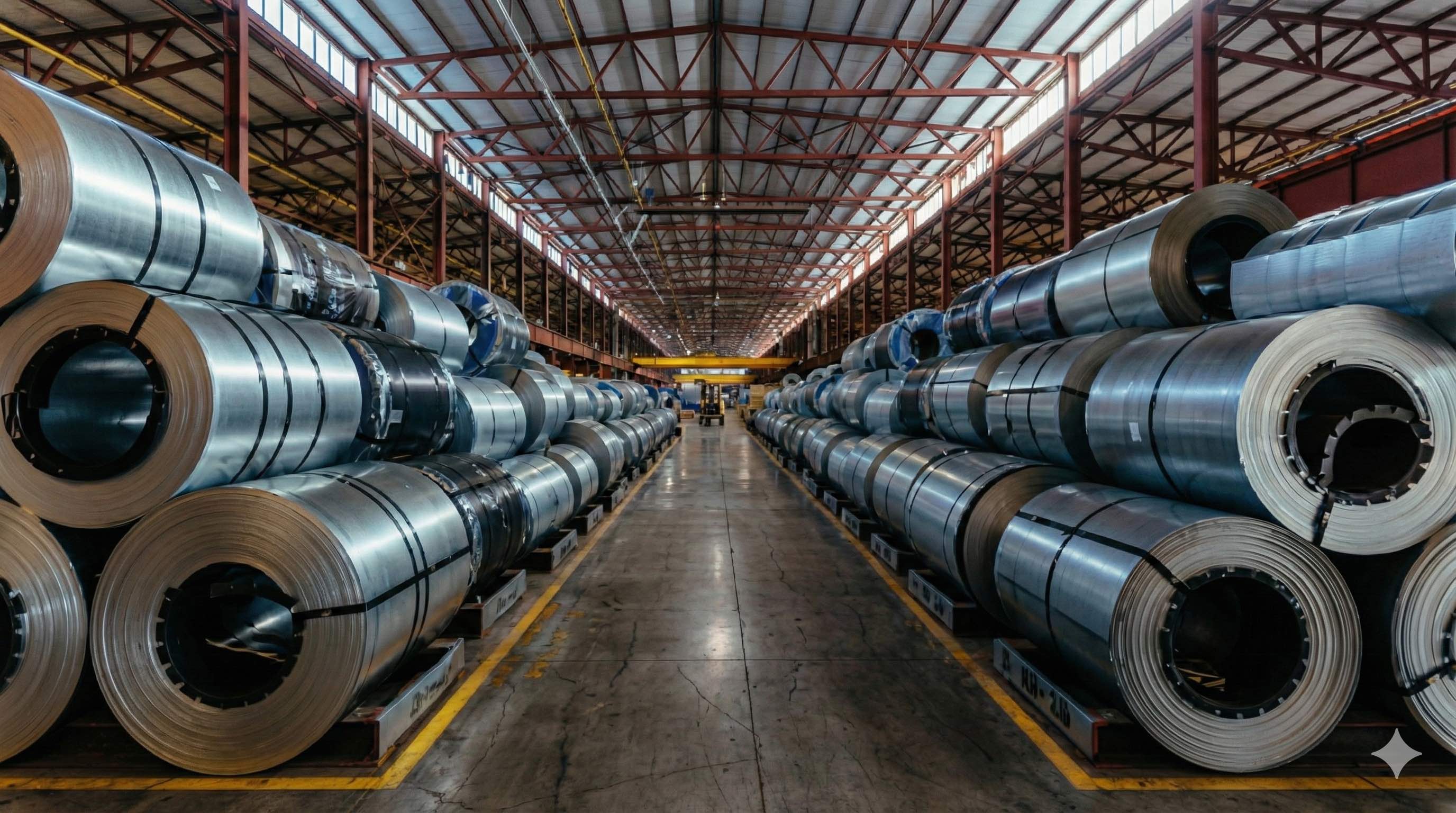
IS 513:2008 is the Bureau of Indian Standards specification for cold rolled low carbon steel sheets and strips. It defines five grades (CR1 to CR5) based on formability — from commercial quality for general fabrication to ultra deep drawing quality for complex press-formed components. CR steel is characterised by its smooth surface finish, tighter dimensional tolerance, and superior formability compared to HR equivalents.
Technical Overview
Cold rolling reduces the thickness of hot rolled coils at room temperature, producing steel with a significantly improved surface finish, flatness, and dimensional accuracy. IS 513 specifies mechanical properties, chemical composition limits, surface condition, and dimensional tolerances for each grade. CR1 and CR2 are the most commonly traded grades, used widely across appliances, furniture, enclosures, and automotive panels. CR3 (deep drawing quality) and CR4 (extra deep drawing) are used by automotive OEMs for body panels and complex stampings. CR5 (ultra deep drawing) is a special order grade. The 2016 revision introduced Part 1 (low carbon) and Part 2 (HSLA) as separate standards.
Grades & Mechanical Properties
| Grade | Notes |
|---|---|
| CR1 | Commercial quality — general fabrication, non-forming applications |
| CR2 | Drawing quality — moderate press forming, furniture, enclosures |
| CR3 | Deep drawing quality — auto panels, complex stampings |
| CR4 | Extra deep drawing — severe forming, complex shapes |
| CR5 | Ultra deep drawing — most demanding press operations, special order |
Values are minimum requirements unless otherwise stated. Always verify with the current edition of the standard and the mill test certificate.
Common Applications
- Automotive body panels, doors, and bonnets
- White goods — refrigerators, washing machines, AC cabinets
- Electrical enclosures, switchgear panels, and server racks
- Furniture — filing cabinets, office storage, racks
- Precision tubes and ERW pipes
- Roofing and cladding substrate for colour coating and galvanizing
International Equivalents
EN 10130 DC01–DC05
European cold rolled steel grades — DC01 = CR1, DC04 = CR3
ASTM A1008
US cold rolled sheet standard for commercial and drawing grades
JIS G3141 SPCC/SPCD
Japanese equivalent — SPCC is commercial quality, SPCD is drawing
Frequently Asked Questions
What is IS 513 steel?
What is the difference between IS 513 CR1 and CR3?
What is CRCA steel?
What thickness is IS 513 cold rolled steel available in?
Related Standards
IS 1079:2017 — Hot Rolled Carbon Steel Sheet and Strip
IS 1079:2017 specifies hot rolled carbon steel sheets and strips for general engineering purposes. It defines four commercial grades — HR1 through HR4 — based on forming characteristics, covering thicknesses from 1.6mm to 10mm in sheet form and strips up to 600mm wide. It is the foundational standard for the hot rolled coil and sheet supply chain in India.
View standard
IS 277:2018 — Galvanized Steel Sheets (Plain and Corrugated)
IS 277:2018 is the BIS specification for hot-dip galvanized steel sheets in plain (GP) and corrugated (GC) form. The standard defines zinc coating weight classes, dimensional requirements, and quality conditions for sheets used in roofing, wall cladding, agricultural buildings, and industrial enclosures. It is the most referenced standard for galvanized sheets in the Indian construction market.
View standard
IS 14246:2013 — Hot Dip Zinc Coated Steel Sheets and Coils
IS 14246:2013 specifies continuously hot-dip zinc coated (galvanized) steel sheets and coils for structural, roofing, and general engineering applications. Unlike IS 277 which focuses on formed roofing sheets, IS 14246 covers the coil form supplied to downstream processors — colour coaters, profilers, roll formers, and fabricators — making it the reference standard for galvanized coil trade in India.
View standard
IS 1852:1985 — Rolling and Cutting Tolerances for Hot Rolled Steel Products
IS 1852:1985 is the BIS standard governing rolling and cutting tolerances for all hot rolled steel products — plates, sheets, strips, flats, bars, and structural sections. It specifies the permitted deviation from nominal dimensions for thickness, width, length, flatness, camber, and squareness. IS 1852 is the tolerance reference document used alongside IS 2062 and IS 1079 in purchase orders and inspection protocols — any dimension check at goods receipt references IS 1852.
View standard