
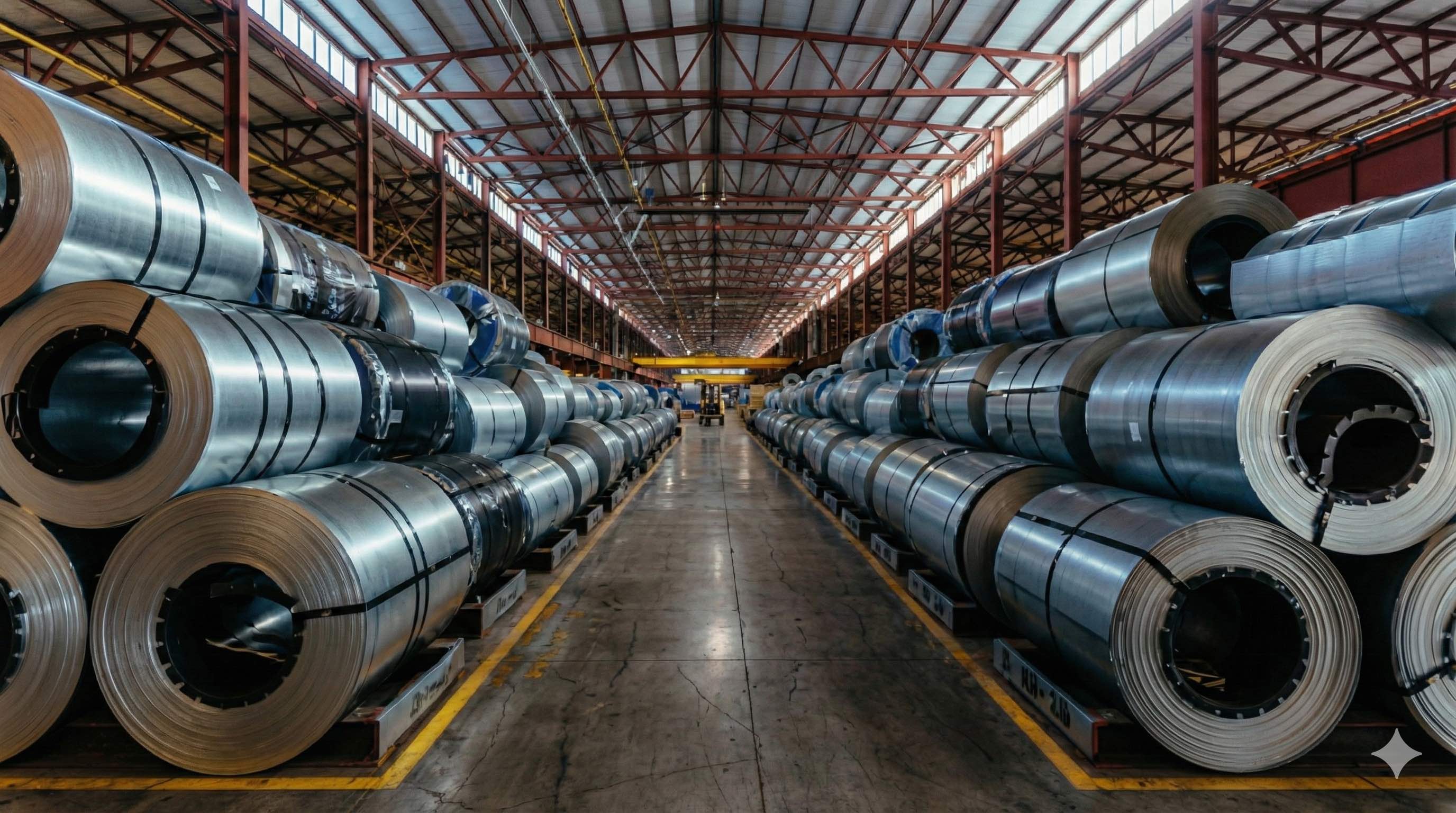
IS 1852:1985 is the BIS standard governing rolling and cutting tolerances for all hot rolled steel products — plates, sheets, strips, flats, bars, and structural sections. It specifies the permitted deviation from nominal dimensions for thickness, width, length, flatness, camber, and squareness. IS 1852 is the tolerance reference document used alongside IS 2062 and IS 1079 in purchase orders and inspection protocols — any dimension check at goods receipt references IS 1852.
Technical Overview
Dimensional tolerances in hot rolling arise from roll wear, thermal expansion, and process variation. IS 1852 codifies acceptable tolerance ranges so that buyers, mills, and inspection agencies have a common reference. Thickness tolerances are expressed as plus/minus deviations from nominal, varying by nominal thickness and product width. Width tolerances for slit products are typically tighter than mill edge (as-rolled) products. Flatness tolerances — expressed as maximum deviation over a 1-metre reference length — are particularly important for laser cutting, press work, and precision fabrication. The standard is referenced in most Indian mill test certificate formats and purchase order terms.
Grades & Mechanical Properties
| Grade | Notes |
|---|---|
| Thickness Tolerance | Varies ±0.1mm to ±1.5mm depending on nominal thickness and width |
| Width Tolerance (mill edge) | +10mm / −0mm for most widths |
| Flatness Tolerance | Max 12mm per metre for general plates; 3mm for precision grades |
| Length Tolerance | +25mm / −0mm for cut-to-length sheets |
Values are minimum requirements unless otherwise stated. Always verify with the current edition of the standard and the mill test certificate.
Common Applications
- Incoming material inspection at fabrication shops
- Goods receipt verification against purchase order
- Laser cutting and press shop flatness acceptance
- Mill certification and test certificate format
- Contractual dispute resolution on dimensional non-conformance
International Equivalents
EN 10029
European thickness tolerance standard for hot rolled steel plate
EN 10051
European standard for dimensional tolerances of continuously hot rolled strip
ASTM A6
US general requirements for structural steel — includes dimensional tolerances
Frequently Asked Questions
What is IS 1852?
Why is IS 1852 important for buyers?
What are typical thickness tolerances under IS 1852?
Related Standards
IS 2062:2011 — Hot Rolled Medium and High Tensile Structural Steel
IS 2062 is India's primary structural steel standard, specifying hot rolled medium and high tensile steel used in bridges, buildings, industrial structures, and fabricated assemblies. It defines six grades from E250 to E550, covering mild to high tensile performance. Published by the Bureau of Indian Standards (BIS), it is the most referenced steel specification in Indian construction and engineering.
View standard
IS 1079:2017 — Hot Rolled Carbon Steel Sheet and Strip
IS 1079:2017 specifies hot rolled carbon steel sheets and strips for general engineering purposes. It defines four commercial grades — HR1 through HR4 — based on forming characteristics, covering thicknesses from 1.6mm to 10mm in sheet form and strips up to 600mm wide. It is the foundational standard for the hot rolled coil and sheet supply chain in India.
View standard
IS 808:2021 — Dimensions for Hot Rolled Steel Beam, Column, Channel and Angle Sections
IS 808:2021 is the BIS dimensional standard for hot rolled steel sections — I-beams (ISMB), columns (ISSC), channels (ISMC), T-sections (ISST), and angles (ISA/ISEA). It specifies the exact dimensions, mass per metre, and section properties (area, moment of inertia, section modulus) for each standard size. IS 808 is the reference document used by structural engineers across India to select sections and by procurement teams to specify and verify supply.
View standard
IS 513:2008 — Cold Rolled Low Carbon Steel Sheets and Strips
IS 513:2008 is the Bureau of Indian Standards specification for cold rolled low carbon steel sheets and strips. It defines five grades (CR1 to CR5) based on formability — from commercial quality for general fabrication to ultra deep drawing quality for complex press-formed components. CR steel is characterised by its smooth surface finish, tighter dimensional tolerance, and superior formability compared to HR equivalents.
View standard